
Credit Education / Bankruptcy Reporting
Credit Report After Bankruptcy Discharge: A Reddit Credit Guide to Errors
Your credit report after bankruptcy discharge should match the court’s order. When discharged debts still show as owed or past due, here’s what to check and how to dispute it.
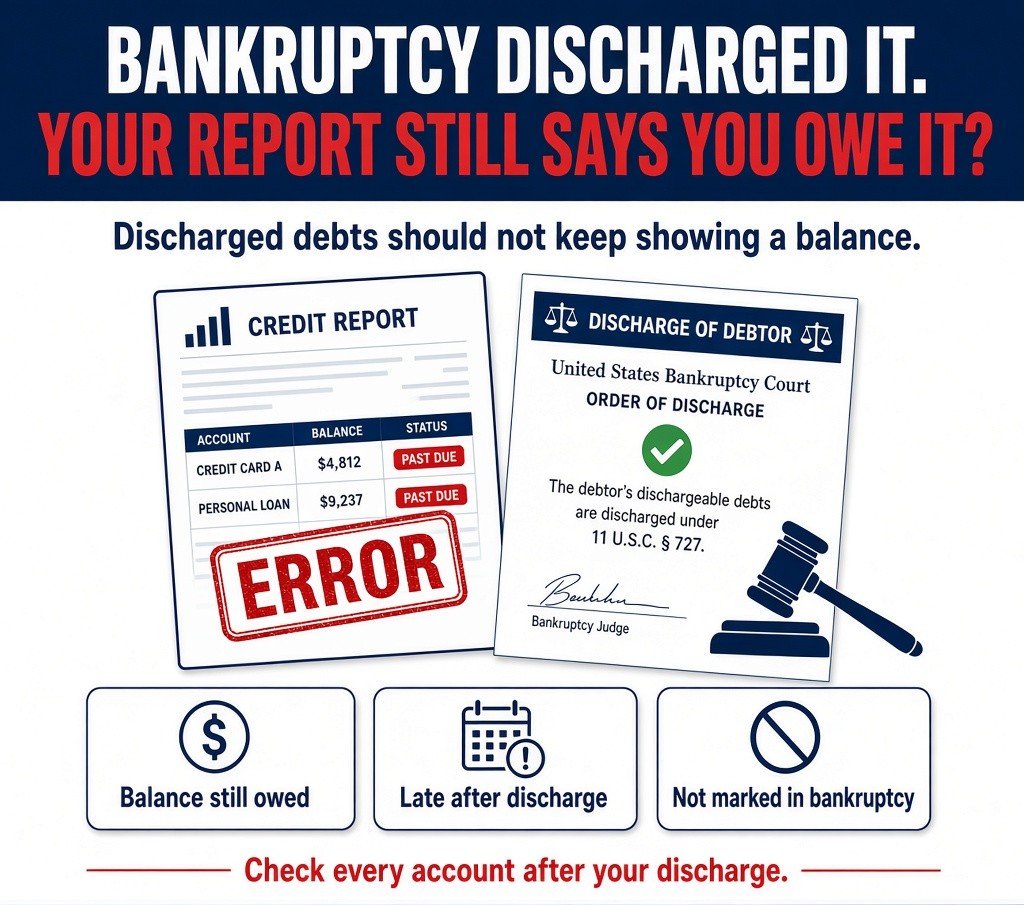
Checking your credit report after bankruptcy discharge is an easy step to skip, and it is often where the surprises are. For readers of Reddit credit communities rebuilding after a bankruptcy, old debts still listed as open, past due or owed in full can keep dragging a score down long after the case is closed.
Credit Repair Co publishes plain-English explainers on credit and consumer reports. Browse the full Reddit Credit Insights collection or learn more about Credit Repair Co.
What your credit report after bankruptcy discharge should show
A bankruptcy discharge releases you from personal liability for certain debts, so you are no longer legally required to pay them. The federal courts’ Bankruptcy Basics guide describes it as a permanent order that prohibits creditors from taking collection action on discharged debts (11 U.S.C. § 524).
Not every debt is discharged. Certain taxes, child support and alimony, most student loans and some other debts generally survive. A valid lien can remain on property, and a debt you reaffirmed is still owed. Start by confirming which debts your discharge actually covered.
For a debt that was discharged, a report that still shows a balance due, or new late payments after the discharge date, may be inaccurate. The account’s history before the bankruptcy, such as late payments that really happened, can generally still appear.
The bankruptcy case itself can be reported for up to 10 years from the date of the order for relief (§ 1681c(a)(1)). The same section requires a report that includes a bankruptcy case to identify the chapter, if the source provides it, and to note a case the consumer withdrew before a final judgment once documentation is received (§ 1681c(d)(1)).
Discharged debt still on credit report: 6 errors to check
- A debt that was discharged still shows a balance owed.
- An account shows new late payments or “past due” after your discharge date.
- An account that was included in your bankruptcy isn’t marked that way.
- An account that was not part of your bankruptcy is marked as included.
- The wrong chapter is listed (for example, Chapter 7 instead of Chapter 13), or the filing or discharge dates are wrong.
- A collection agency or debt buyer reports a discharged debt as if it were a new, unpaid collection.
Account included in bankruptcy, or wrongly marked
Both directions matter. If a discharged account isn’t marked as included in bankruptcy, it can look like a debt you simply stopped paying. If an account you kept and paid, such as a reaffirmed car loan or a card opened after filing, is wrongly marked as included, it can hide positive payment history.
Debts discharged in Chapter 7 vs. Chapter 13
The timing differs by chapter, so the dates on your report should match your docket. According to the federal courts, a Chapter 7 discharge usually comes about four months after filing. In Chapter 13, the discharge generally comes after you finish your plan payments, typically about four years after filing.
How to dispute bankruptcy on credit report errors
- Get all three reports. Pull your Equifax, Experian and TransUnion reports from AnnualCreditReport.com and mark every account that was part of the case.
- Gather your court papers. You’ll want the discharge order, the docket with your case number and dates, and the schedule pages that list each creditor.
- Dispute each error in writing. Send a dispute to each bureau reporting the error. Identify the account, explain what’s wrong (for example, “discharged on [date], should show $0 balance and included in bankruptcy”), and attach copies, not originals. The CFPB explains the process.
- Dispute with the company reporting it, too. When a bureau forwards your dispute, the creditor or collector that furnished the information must investigate and correct or delete information it finds inaccurate, incomplete or unverifiable (§ 1681s-2(b)).
- Track the results. A bureau generally must finish its reinvestigation within 30 days (§ 1681i). Check each report again afterward, because one bureau may fix an account that another still shows wrong.
Accurate history can stay. A dispute corrects inaccurate or incomplete reporting; it doesn’t erase late payments that really happened before the bankruptcy, or the bankruptcy itself within the legal time limit.
If a denial letter arrives after your discharge, read it closely. When a lender takes adverse action based on a credit report, it generally must name the bureau that supplied it (§ 1681m). That tells you which report to check first.
If a creditor or collector is still trying to make you pay a discharged debt, that is a separate issue under the Bankruptcy Code. Keep every letter and a log of calls.
What to keep
- Your bankruptcy discharge order and the filing docket (case number and dates).
- Your schedules listing each creditor included in the case.
- Your credit reports from Equifax, Experian and TransUnion.
- Any denial or adverse action letter you received after the discharge.
- Copies of every dispute letter you sent and each reply.
Related Reddit Credit guides
Our credit report errors guide covers the most common reporting problems, including mixed files and deleted items that reappear. For a related situation where an account was paid but still reported, see our explainer on a new FCRA case over a paid-off debt that kept being reported negatively.
If disputes stall, our explainer on how CFPB complaints now work covers what to do next, and our TransUnion credit washing explainer shows why it pays to dispute only items that are actually wrong.
The takeaway
For anyone rebuilding after bankruptcy and reading Reddit credit communities for answers, the fix usually starts with paperwork. Pull all three reports, line them up against your discharge order and schedules, and dispute each account that doesn’t match.
This article reflects federal law as of November 14, 2026, and is general information about consumer reporting after bankruptcy, not advice about your bankruptcy case.
Found discharged debts still showing as owed? Our credit repair team disputes inaccurate or unverifiable items with the bureaus and creditors. If the law may have been violated, our legal partners can review your situation at no out-of-pocket cost to you. Every case is different, and outcomes depend on the facts. Call 415-569-3151 (Mon–Fri, 9am–5pm Pacific), see our credit repair services, read why clients choose Credit Repair Co, or contact our team. Educational only. Not legal advice.
Sources: U.S. Courts: Discharge in Bankruptcy (Bankruptcy Basics); 11 U.S.C. § 524 (effect of discharge); 15 U.S.C. § 1681c (reporting time limits; chapter identification); 15 U.S.C. § 1681e (accuracy procedures); 15 U.S.C. § 1681i (reinvestigation); 15 U.S.C. § 1681s-2 (furnisher duties); 15 U.S.C. § 1681m (adverse action notices); CFPB: How do I dispute an error on my credit report?; AnnualCreditReport.com
One Response