
Credit Education / Eviction Records
Dismissed Eviction Still on Record? A Reddit Credit Guide to Tenant Screening
A dismissed eviction still on record can make a screening report look worse than your real rental history. Here’s what an accurate eviction entry should show and how to dispute one that doesn’t.
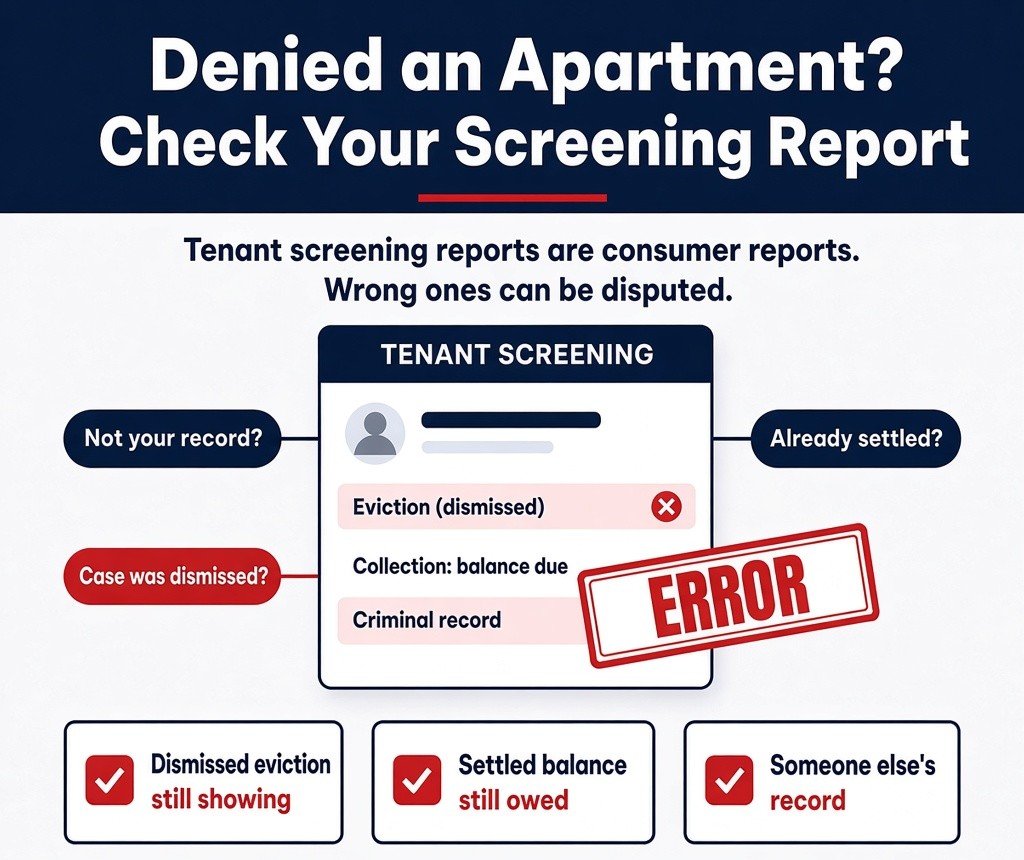
Finding a dismissed eviction still on record is one of the most frustrating rental surprises, because the case ended in your favor or never went anywhere. For readers of Reddit credit communities facing a rental denial, the real question is not just whether an eviction appears, but whether the report tells the whole story.
Credit Repair Co publishes plain-English explainers on credit and consumer reports. Browse the full Reddit Credit Insights collection or learn more about Credit Repair Co.
Why a dismissed eviction still on record shows up
Evictions are court cases, so tenant screening companies pull court records. One case can create several entries over time: the filing, hearings, a judgment or dismissal, and sometimes a later satisfaction or sealing order. If a screening company captures the filing and never picks up the outcome, the report can make it look as though you were evicted.
Regulators have described this exact problem. In 2023, the CFPB and FTC alleged that TransUnion Rental Screening Solutions provided tenant screening reports with eviction records that showed only that a case was filed when a final outcome was available, sometimes reported a judgment for the landlord when the case was actually dismissed, listed one case as several entries, and included sealed records.
The companies settled for $15 million. According to the CFPB, the order required written procedures to keep eviction proceedings without a final outcome, and duplicate filings for a single case, out of its reports. The CFPB terminated that order in November 2025 after finding TransUnion had met its obligations.
What an accurate eviction entry should show
The CFPB’s rental background check checklist lists what to look for. Use it line by line:
- The final outcome. If an eviction filing was dismissed, the entry should say “dismissed.” A filing shown without the dismissal should be corrected.
- One case, one entry. Different stages of the same case, such as the filing and a judgment for possession, should not look like multiple evictions.
- No sealed or expunged records. If your eviction record was sealed or expunged, it should not be on the report.
- Nothing outdated. Federal law generally bars negative information like evictions from being reported after seven years.
- Correct amounts. If you paid some or all of a judgment, the amount owed should reflect it.
Behind all of this is the FCRA’s accuracy rule: a screening company must follow reasonable procedures to assure maximum possible accuracy (§ 1681e(b)).
How long does an eviction stay on a tenant screening report?
Under § 1681c(a)(2), civil suits and civil judgments generally can’t be reported once they are more than seven years old from the date of entry, or until the governing statute of limitations expires, whichever is longer. The CFPB summarizes this for renters as a general seven-year limit on negative information like evictions.
A dismissed case is still a court record, so it may appear within that window. What matters for accuracy is that the report shows the dismissal rather than suggesting you lost.
Some states and cities go further, including laws that let courts seal certain eviction records. Those rules vary, so check with the court where the case was filed.
Sealed eviction record vs. dismissed eviction
A dismissed eviction means the case ended without a judgment for the landlord, but the file may still be public. A sealed eviction record means a court has restricted public access to it. The CFPB says sealed or expunged eviction records should not appear on your report at all.
Remove eviction from tenant screening reports? Dispute it when it’s wrong
You can’t dispute away an accurate eviction judgment that is still within the time limit. But you can dispute an entry that is inaccurate, incomplete or outdated. Here’s the order that usually works best:
- Get the adverse action notice. If a landlord denies you, requires a co-signer, or charges a higher deposit or rent because of a report, it must tell you and name the screening company (§ 1681m; CFPB).
- Request your free copy within 60 days. You’re entitled to a free copy from the company the landlord used if you ask within 60 days of the denial (§ 1681j(b)).
- Pull the court record. Get the dismissal order, the case docket, any settlement agreement, and any sealing or expungement order.
- Dispute in writing. Send the screening company a dispute that names the exact entry, the case number and what’s wrong, with copies of your court papers. The CFPB also suggests contacting the company that supplied the record and, for eviction errors, the court.
- Track the deadline. The company generally has 30 days to investigate, sometimes 45 (§ 1681i). Ask for the results in writing and an updated copy.
Correcting a report fixes inaccurate or outdated information. It doesn’t mean a landlord must change its decision, and accurate eviction judgments can generally be reported within the legal time limits.
Do evictions show up on background checks?
On tenant screening reports, often yes. The CFPB notes that rental background checks can include eviction records, criminal records, civil judgments and credit history, sometimes all in one report.
Other background checks depend on what the employer or company orders. If a different kind of report cost you a job, our guide to background check errors covers how those reports work and how to dispute them.
What to keep
- The tenant screening report, plus the landlord’s denial or adverse action letter.
- Court papers: the dismissal order, docket, settlement agreement or sealing order.
- Proof that any old balance with a prior landlord was settled or paid.
- Copies of every dispute letter and reply, with dates.
How this differs from our tenant screening guide
Our earlier tenant screening report errors guide covers the full range of screening problems, including settled balances, mixed files and someone else’s criminal record. This guide zooms in on eviction records, the entry that most often decides a rental application.
If the screening report included a credit report, our credit report errors guide explains how to dispute with Equifax, Experian and TransUnion. And if a dispute goes nowhere, our explainer on how CFPB complaints now work covers that next step.
The takeaway
For anyone reading Reddit credit communities after a rental denial, the next step is concrete. If a dismissed eviction is still showing as if you lost, get the report and your court papers, then dispute the specific entry with the screening company in writing.
This article reflects federal law and CFPB guidance as of November 14, 2026; state and local rules vary.
Turned down for a rental over a report you think is wrong? Our credit repair team disputes inaccurate or unverifiable items with the bureaus and creditors. When a tenant screening error may have cost you housing, our legal partners can review your situation at no out-of-pocket cost to you. Every case is different, and outcomes depend on the facts. Call 415-569-3151 (Mon–Fri, 9am–5pm Pacific), see our credit repair services, read why clients choose Credit Repair Co, or contact our team. Educational only. Not legal advice.
Sources: CFPB: Review your rental background check; CFPB: What should I do if my rental application is denied because of a tenant screening report?; CFPB/FTC complaint v. TransUnion Rental Screening Solutions (Oct. 2023); CFPB: Prepared remarks on the TransUnion enforcement actions; CFPB: TransUnion action and Nov. 2025 order termination; 15 U.S.C. § 1681c (reporting time limits); 15 U.S.C. § 1681e (accuracy procedures); 15 U.S.C. § 1681i (reinvestigation); 15 U.S.C. § 1681j (free disclosures); 15 U.S.C. § 1681m (adverse action notices)
4 Responses