
Medical Debt / Collections
Reddit Credit Guide: Surprise Medical Debt Collections
A hospital system closes, and 17 months later the collection calls start, for bills people say were already paid. Here’s how to check medical debt collections before a single dollar leaves your account.
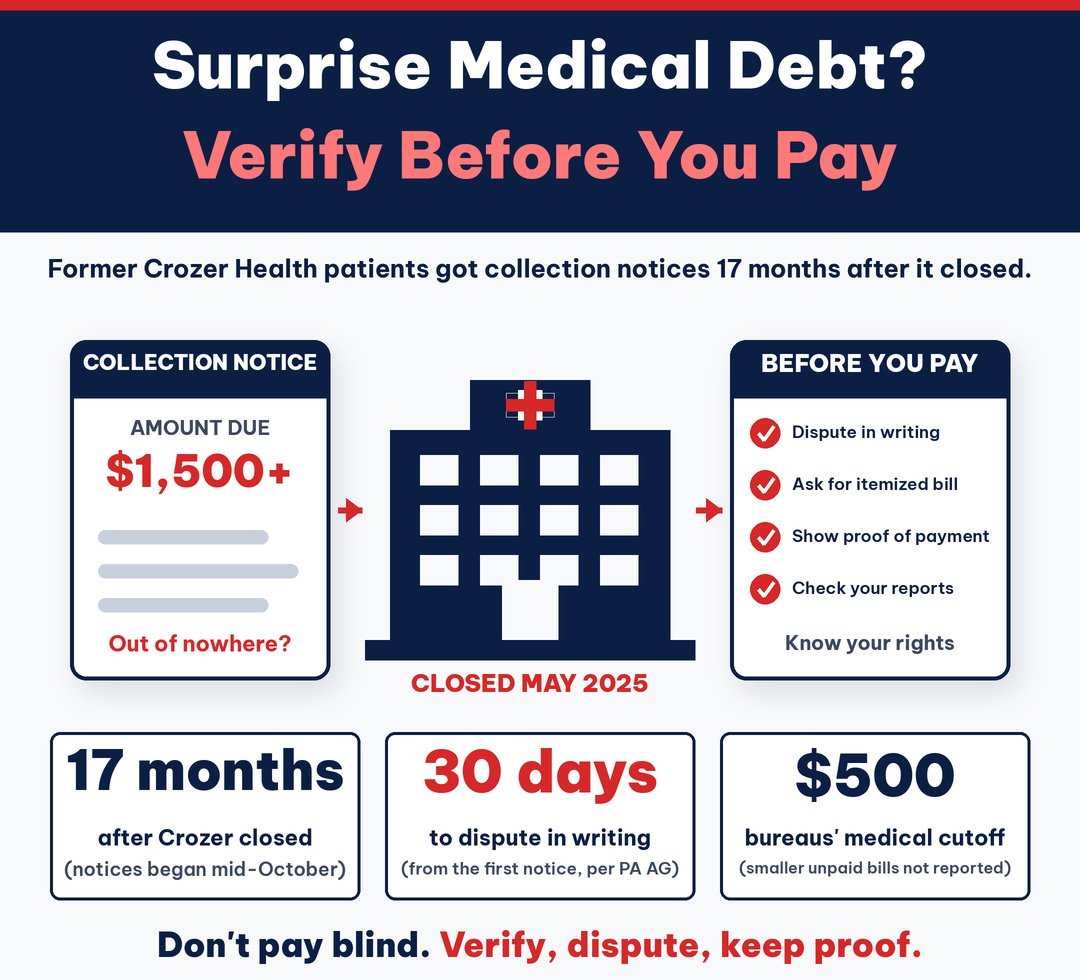
In this Reddit Credit Guide, we break down what people on Reddit are asking about surprise medical debt collections: a collector calls about a hospital bill you never got, says you owe hundreds or thousands, and wants a payment today. Do you pay it to make it go away, or push back? Short answer: you check it first.
Credit Repair Co writes plain-English guides to credit reports and the rules behind them. Learn more about Credit Repair Co, see our services, or browse the full Reddit Credit Insights collection.
Surprise medical debt collections 17 months after a hospital closed
Here’s the news that kicked off this guide to medical debt collections. WHYY News reported on November 18, 2026 that former patients of Crozer Health, a three-hospital system outside Philadelphia that closed in May 2025, started getting debt collection calls and notices in mid-October. That’s about 17 months after the doors shut.
According to WHYY, the calls, the notices and even some alerts from credit bureaus are linked to United MediCorp LLC and other companies that bought up Crozer’s unpaid medical debt. One patient was told she owed more than $1,500 for a 2024 colonoscopy she says insurance covered, and she says she never got a bill. On the call, the collector asked if she could do $500 and offered to knock a few hundred dollars off if she paid that day. Another patient is fighting a claim of more than $900, and she’s gathering receipts, medical records and insurance documents to do it.
Pennsylvania State Sen. Tim Kearney told WHYY the amounts are "all over the place," from $10 to thousands of dollars, and that most of his constituents who reached out said the charges had already been paid.
Update, November 23, 2026: Pennsylvania’s Attorney General announced an agreement with United MediCorp to temporarily stop its collection efforts from former Crozer patients while his office looks into potential discrepancies. The office said the company had been sending demands with inaccurate or outdated billing information. A pause isn’t the same as the debt being wiped out, so keep your paperwork and keep checking your credit reports.
Why medical debt collections can show up out of nowhere
You might wonder how medical debt collections start on a bill you never saw. WHYY explains part of it: in most cases, hospitals and health offices have to submit claims to insurers within a set timeframe, usually somewhere between 90 days and one year. If they miss it, the insurer can deny payment, and the health system may then try to bill the patient directly. But WHYY also notes people aren’t always obligated to pay when the health system failed to bill insurance properly.
Then there’s the sale, which is where a lot of medical debt collections get messy. When unpaid hospital accounts are sold to debt buyers, the information that travels with them isn’t always clean. The Pennsylvania Attorney General’s office warned that the collector’s bills may be "inaccurate, incomplete or improperly assigned."
One quick clarification, because the words overlap: "surprise billing" also has a legal meaning. The CFPB explains that the No Surprises Act, effective January 1, 2022, protects many insured patients from certain surprise bills, like out-of-network charges for emergency services (CFPB). In this guide, "surprise" just means a collection you didn’t see coming. If your bill is an out-of-network surprise bill, that law may apply too.
Don’t pay on the first call, even for a discount
A "pay today and we’ll take a few hundred off" offer can feel like a deal. But with medical debt collections, if you don’t owe the bill, any amount is too much. Paying a bill you don’t actually owe isn’t the fix. Checking it is.
The CFPB says debt collectors aren’t allowed to ask you to pay charges you don’t actually owe, such as services you didn’t receive, inflated charges, or bills that were already paid by you or your insurance (CFPB consumer advisory). It also says that when a collector first contacts you, it generally has to give you validation information, including the name of the creditor, the amount you owe and how to dispute it, during that first contact or within five days. If a collector doesn’t or can’t give you that, it could be a scam, and you shouldn’t hand over sensitive financial information (CFPB).
So when medical debt collections reach you by phone, keep that first call simple:
- Ask for everything in writing, including the validation notice.
- Write down the date, the company name, the person’s name and what they said.
- Don’t give card or bank details, and don’t agree to a payment yet.
- Don’t ignore it either. The CFPB notes that ignoring a valid debt usually won’t make the collector go away.
How to verify medical debt collections in writing
This is the heart of it. The Pennsylvania Attorney General lays out the steps for anyone who got one of these collection letters, and they work as a general checklist for medical debt collections anywhere:
- Send a written dispute within 30 days of getting the first notice, with any proof you have that the debt was already satisfied.
- Request full verification of the debt (the table below shows what to ask for).
- Keep copies of everything you send and everything you get back.
| Ask for | Why it helps |
|---|---|
| Proof the agency has the legal authority to collect | The debt may have been sold. You want to see that this company actually has the right to come after you. |
| An itemized statement of services | It lets you match each charge against your insurance Explanation of Benefits and your own receipts. |
| The date(s) of service | Dates help you find the right visit in your records, and spot care you don’t remember getting. |
| Documents showing the amount is accurate | A balance with no paper trail behind it is exactly what you want to question. |
Why the 30 days matter for medical debt collections: the CFPB says that if you dispute in writing within 30 days of getting a validation notice, the collector has to stop collecting until it sends you verification that responds to your dispute (CFPB). After it sends verification, collection can start again, and you can keep disputing if you still disagree. The Attorney General’s office adds that if the agency fails to provide adequate evidence, it isn’t permitted to keep trying to collect. And as Attorney General Dave Sunday put it, consumers who wish to dispute bills "can do so without being penalized."
You can also ask for the name and address of the original creditor if it’s different from the company contacting you. The CFPB says that if you ask in writing within 30 days, the collector has to stop collecting until it gives you that information (CFPB). With a sold hospital debt, that detail matters.
Send your letter by certified mail. One former Crozer patient told WHYY she did exactly that, so she’d have proof of when the agency got it. The CFPB also offers sample letters for "I do not owe this debt" and "I need more information about this debt," which you can adapt.
Reddit medical debt collections tip: missed the 30-day window? Dispute anyway. The CFPB says you can submit a dispute at any time; the 30 days is what triggers the pause on collection.
Gather your proof before you send anything
With medical debt collections, proof that the bill was paid or covered is your strongest tool. The Attorney General’s office lists the kinds of documents that help:
- Your insurance Explanation of Benefits (EOB) for that visit.
- A canceled check, a credit card or bank statement, or a receipt showing payment.
- Any letters about the bill, and every collection notice, with the date you got it.
Send copies, not originals. The CFPB says to keep your originals as proof (CFPB). It’s also worth calling your health insurer to confirm whether the claim was paid. If your records are thin, the CFPB suggests asking for an itemized bill and checking it for things like being charged twice for the same service, or insurance not being applied correctly.
One more deadline if you were a Crozer patient: Sen. Kearney told WHYY that most Crozer records are scheduled to be destroyed after March 2, 2027. If you might need your medical records to fight a bill, request copies now.
When medical debt collections show up on your credit report
Here’s why this matters if you’re working on your credit. Medical debt collections, including debts a collector bought, can land on your credit report. WHYY reports that Equifax, Experian and TransUnion don’t report unpaid medical debt under $500, and, per Experian, larger unpaid medical debt is typically included only after it has been in collections for at least a year. Once it’s there, it can stay up to seven years or until it’s paid.
So when you review medical debt collections on your reports, check a few things:
- Is a medical collection under $500 showing? Based on the bureaus’ own policy as WHYY describes it, it shouldn’t be. Dispute it.
- Is a paid or insurance-covered bill showing as unpaid? Dispute it, with your EOB or proof of payment.
- Is the same medical bill listed twice, once by the original creditor and again by a collector, both with a balance? Our guide to duplicate debt and reinserted items walks through that.
- Are the dates or amounts wrong? Note exactly what’s off before you dispute.
Pull your reports from all three bureaus for free at AnnualCreditReport.com. If you find a disputed debt on your report, the CFPB says you can dispute it with the credit reporting companies too, not just the collector (CFPB). For how collections work on a report in general, see our debt in collections guide, and for the dispute process across all three bureaus, our credit report errors guide.
When a medical collection hurts your credit report
Our credit repair team handles the everyday work: disputing inaccurate or unverifiable collections and other items with the credit bureaus and the companies reporting them, and you can get a free review at no out-of-pocket cost. If medical debt collections that are wrong, paid or not yours show up on your credit report, or you’re dealing with identity theft accounts or a mixed file, and it cost you credit, a job, housing or insurance, Credit Repair Co’s Program 2, a Free Report Error Review by Our Legal Partners may be worth a look. It covers errors on credit reports, employment background checks, tenant screening reports and insurance reports. The attorneys we work with review your situation at no out-of-pocket cost to you and let you know whether they can help and what your options are. Under the Fair Credit Reporting Act, a consumer may be entitled to compensation and to have inaccurate information corrected or deleted if the law was violated.
To be clear about what that is and isn’t: Credit Repair Co is not a law firm, and report error reviews are done by the attorneys we work with. A free review doesn’t guarantee that anyone can take the case or that you’ll get any particular outcome, and results vary from person to person. Time limits can apply, so keep your collection letters, credit reports, dispute letters and certified mail receipts together and reach out while the details are fresh.
Medical debt collections FAQ
Should I pay a medical debt collector on the first call?
No. Ask for everything in writing first, including the validation notice, and don’t share card or bank details yet. The CFPB says collectors aren’t allowed to ask you to pay charges you don’t owe, like bills already paid by you or your insurance.
How long do I have to dispute medical debt collections?
Send a written dispute within 30 days of the first notice. The CFPB says a written dispute within 30 days of the validation notice makes the collector stop collecting until it sends verification. You can still dispute after that, but the pause may not apply.
What should I ask for in a debt validation request?
The Pennsylvania Attorney General’s office suggests asking for proof the agency has the legal authority to collect, an itemized statement of services, the dates of service, and any documents showing the amount is accurate. Keep copies of everything.
Can medical debt under $500 go on my credit report?
According to WHYY, Equifax, Experian and TransUnion don’t report unpaid medical debt under $500. Larger unpaid medical debt is typically reported only after a year in collections, per Experian, and can stay up to seven years or until paid. If smaller medical debt collections show up, dispute them.
What if my insurance already paid the bill?
Send copies of your Explanation of Benefits, receipts or card statements with your written dispute, and keep the originals. Call your insurer to confirm the claim was paid. If the collection is on your credit report, dispute it with the bureaus too.
Related Reddit Credit guides
Want to keep going after this Reddit medical debt collections guide? Start with our Reddit Credit Guide to debt in collections, then read how to handle the same debt reported twice or a deleted item that came back. For the full dispute process, see our credit report errors guide. And for help with inaccurate items on your credit reports, see our page on credit report repair services.
The takeaway: 5 free, smart tips
- Don’t pay on the first call, even if they offer a discount for paying today.
- Dispute in writing within 30 days of the first notice and ask for full verification, including an itemized bill.
- Pull your Explanation of Benefits, receipts and statements, and send copies by certified mail.
- Check all three credit reports at AnnualCreditReport.com and dispute any medical debt collections that are wrong, paid or under $500.
- Keep every letter, note and receipt in one folder.
Surprise medical debt collections are stressful, and that’s partly the point of a "pay today" offer. Slow it down. Verify first, dispute in writing, and keep proof. If the debt is real, you’ll know exactly what you owe. If it isn’t, you’ll have the paper trail to show it.
This article is based on WHYY News reporting (November 18, 2026), Pennsylvania Attorney General releases (November 10 and 23, 2026) and CFPB guidance available through November 23, 2026. It describes medical debt collections in general, not any specific case. Collection and credit reporting rules can change, and state laws vary.
Found a medical collection on your report you don’t think you owe? Call 415-569-3151 (Mon–Fri, 9am–5pm Pacific), visit Credit Repair Co, see our services, watch our reviews and results, read why thousands trust us, or contact us for a free review. Educational only. Not legal advice.
Sources: WHYY News: Crozer Health system closed, leaving many patients in a lurch. 17 months later, debt collection notices arrived (Nov. 18, 2026); PA Office of Attorney General: AG Sunday urging former Crozer Health patients to verify debt collector’s info (Nov. 10, 2026); PA Office of Attorney General: AG Sunday announces temporary suspension of bill collection efforts (Nov. 23, 2026); CFPB: Can a debt collector still collect a debt after I’ve disputed it?; CFPB: What can I do if a debt collector contacts me about a debt I already paid or don’t think I owe?; CFPB: What should I do when a debt collector contacts me?; CFPB: What should I do if I can’t pay a medical bill?; CFPB consumer advisory: Pause and review your rights when you hear from a medical debt collector; AnnualCreditReport.com