
Credit Cards / Credit Reports
Reddit Credit Guide: Credit Card Closed by the Issuer
You paid on time, and the card got shut down anyway. Here’s what issuers are allowed to do, the notice you may be owed, and what to check on your credit report next.
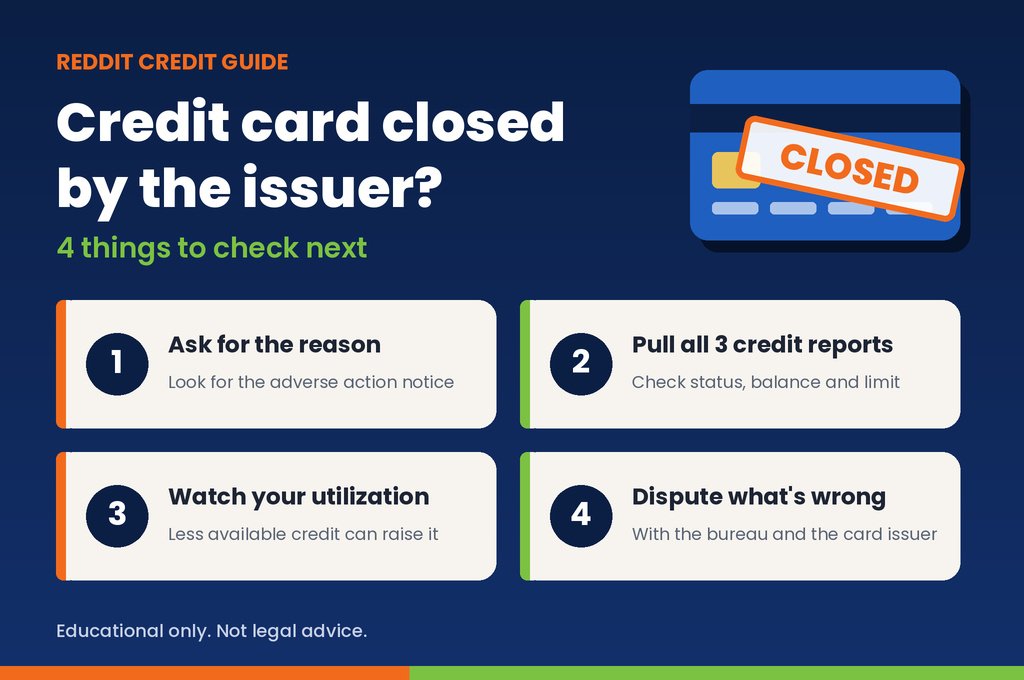
In this Reddit Credit Guide, we break down what people on Reddit are asking about a credit card closed by the issuer, even when every payment was on time. It usually comes as a surprise, and the first question is always the same: how bad is this for my credit?
Credit Repair Co writes plain-English guides to credit reports and the rules behind them. Learn more about Credit Repair Co, see our services, or browse the full Reddit Credit Insights collection.
A credit card closed out of nowhere: the Reddit question
A recent thread on r/CRedit laid out a situation a lot of people will recognize. The poster had a card for about two years, never paid late, and paid the balance in full every month. Then one payment went out from the wrong bank account. They called the issuer, were told to redo the payment and let the first one bounce, and did exactly that. A little later the account showed as restricted, and a second call confirmed the card had been closed over the failed payment. The rep could see the notes from the first call but said the decision was final.
Their question was simple: how much does a credit card closed like this hurt my credit, and what do I do now?
It’s a fair question, and the thread had plenty of opinions. Several replies made the point that the closure itself isn’t really the problem; the bigger issue is what it does to your utilization. That lines up with what the Consumer Financial Protection Bureau says, so let’s walk through it piece by piece.
Can a card issuer close your account? Usually, yes
This part isn’t the answer anyone wants, but it’s the honest one. The CFPB says most card issuers reserve the right to close an account at any time, "and are permitted to do so under the law" (CFPB). It also says card issuers generally can close an account without giving you notice first (CFPB).
The CFPB’s advice for that situation is short: call your card issuer to see what you can do. If your credit card closed because of a misunderstanding, like a payment that bounced after you were told to resubmit it, say so plainly and ask whether the decision can be reviewed. It costs nothing to ask, and it gives you a record of the call.
Reddit credit card closed tip: write down the date and time of every call, the name or ID of the person you spoke with, and what they told you. If you were told to do something, like resubmit a payment, note that too.
The adverse action notice: your right to know why
Here’s the part many people miss. In most instances, the CFPB says, the card issuer must give you an "adverse action notice" when it makes certain unfavorable changes to your account, or when it terminates your account. That notice should either give the specific reasons or tell you how to request them (CFPB).
The rule behind that is Regulation B, which implements the Equal Credit Opportunity Act. It defines adverse action to include "a termination of an account" that doesn’t affect all or substantially all of a class of the creditor’s accounts (12 CFR § 1002.2(c)). When adverse action is taken on an existing account, the creditor has to notify you within 30 days (12 CFR § 1002.9). The written notice has to include:
- A statement of the action taken (here, closing your account).
- The name and address of the creditor, plus the federal agency that oversees it.
- Either the specific reasons, or a notice that you can ask for them within 60 days. If you ask in time, the creditor has 30 days to give you the reasons.
And the reasons have to be real reasons. Reg. B says statements that the action was based on the creditor’s "internal standards or policies" are not enough.
When you might not get a notice
There’s an important exception. Reg. B says adverse action doesn’t include actions taken in connection with inactivity, default or delinquency on that account. So if your credit card closed because it sat unused, or because the issuer treats something on the account as a default, you may not get a formal notice. If you’re not sure which applies, ask the issuer in writing for the reason.
How a credit card closed by the issuer can affect your credit
The CFPB puts it this way: "Closing your account may negatively affect your credit score because closing the account will lower the amount of available credit you have and increase the percentage of available credit you are using" (CFPB). That percentage is your credit utilization.
So for most people, a credit card closed by the issuer is mostly a math problem. If the card had a high limit and you carry balances on other cards, your utilization can jump. If you pay your other cards in full and still have plenty of open credit, the change may be small. The CFPB’s general tip is to keep your credit use at no more than 30 percent of your total limit, which also gives you a cushion if a limit gets cut or a card gets closed.
| On your report | What to expect |
|---|---|
| Available credit | Goes down. The closed card’s limit no longer counts toward the credit you have open. |
| Utilization | Can go up if you carry balances on other cards, because the same balances now sit against less available credit. |
| Balance owed | Still yours to pay. A closed account can keep a balance until it’s paid off. |
| Past payments | Shouldn’t change. On-time months don’t turn into late ones because the card was closed. If they do, dispute it. |
| Account status | Should say closed. The CFPB lists "closed accounts reported as open" as a common error. |
One more thing about money. A credit card closed doesn’t mean the balance disappears. Writing about closures after a cardholder opts out of new terms, the CFPB notes you don’t have to pay the balance in full immediately, but you’re still responsible for making payments until it’s paid off. If there’s a balance, keep paying on time. A missed payment after a closure is a new problem you don’t need.
What to check on your credit report after a credit card closed
Once the dust settles, pull your reports and look at how the credit card closed by the issuer is being reported. The CFPB’s list of common credit report errors includes several that can show up around a closure:
- Closed accounts reported as open. The status should match what actually happened.
- Accounts incorrectly reported as late or delinquent. A bounced payment you fixed right away shouldn’t turn into a string of late marks if you weren’t actually late.
- An incorrect current balance. If you paid in full, the balance shouldn’t show money you don’t owe.
- An incorrect credit limit. A wrong limit can make your utilization look worse than it is.
- Owner vs. authorized user. If you were only an authorized user on the card, you shouldn’t be reported as the owner.
If something’s wrong, the CFPB says to contact both the credit reporting company and the company that provided the information. Under the Fair Credit Reporting Act, a furnisher that finds it reported something incomplete or inaccurate has to promptly send the bureau corrections (15 U.S.C. § 1681s-2(a)(2)). A bureau generally has 30 days to reinvestigate a dispute (15 U.S.C. § 1681i), and it has to follow reasonable procedures to assure "maximum possible accuracy" (15 U.S.C. § 1681e(b)).
What to do: a credit card closed checklist
- Call the issuer. Ask why the account was closed and whether the decision can be reviewed. Take notes on every call.
- Watch for the notice. If it doesn’t list specific reasons, ask for them in writing within 60 days. Keep the envelope or email.
- Pull all three reports. You can check your Equifax, Experian and TransUnion reports for free every week at AnnualCreditReport.com. A closed card may be reported differently by each one.
- Check the details. Status, balance, credit limit, payment history and whether you’re listed as owner or authorized user.
- Dispute anything wrong. Write to the bureau and the card issuer, point to the exact line, and include copies (never originals) of your proof, like statements or a confirmation of the payment you resubmitted.
If you need the card, the issuer may tell you that you’re welcome to apply again. That’s a new application and a fresh decision, so wait until you’ve checked your reports and know the reason for the closure.
When a credit card closed turns into a credit report error
Our credit repair team disputes inaccurate items with the credit bureaus and the companies reporting them, and you can get a free review at no out-of-pocket cost. If a report error after a closure, like late payments that never happened or a balance you already paid, led to a denial or a worse rate, Credit Repair Co’s Program 2, a Free Report Error Review by Our Legal Partners may be worth a look. It covers errors on credit reports, employment background checks, tenant screening reports and insurance reports. The attorneys we work with review your situation at no out-of-pocket cost to you and let you know whether they can help and what your options are. Under the Fair Credit Reporting Act, a consumer may be entitled to compensation and to have inaccurate information corrected or deleted.
To be clear about what that is and isn’t: Credit Repair Co is not a law firm, and report error reviews are done by the attorneys we work with. A free review doesn’t guarantee that anyone can take the case or that you’ll get any particular outcome, and results vary from person to person. Time limits can apply, so keep your reports, letters and notes together and reach out while the details are fresh.
Credit card closed FAQ
Can a credit card company close my account even if I always paid on time?
Generally, yes. The CFPB says most card issuers reserve the right to close an account at any time and are permitted to do so under the law. It also says issuers generally can close an account without giving you notice first.
Do they have to tell me why my card was closed?
In most instances, the CFPB says, the issuer must send an adverse action notice when it terminates your account. The notice should give specific reasons or explain how to request them. Under Regulation B, you can ask for the reasons within 60 days, and the creditor then has 30 days to provide them. Closures tied to inactivity, default or delinquency on the account are an exception.
Does a credit card closed by the issuer hurt my credit score?
It can. The CFPB says closing an account may lower your score because it reduces your available credit and raises the percentage of credit you’re using. How much depends on your balances and the credit you still have open.
Do I still have to pay the balance on a closed card?
Yes. A closed account can still carry a balance, and you’re responsible for paying it. Keep making on-time payments until it’s paid off.
What if my report shows the card as open or shows late payments I didn’t make?
Those are on the CFPB’s list of common credit report errors. Dispute them with the credit reporting company and the card issuer, in writing, with copies of your proof. The bureau generally has 30 days to reinvestigate.
Related Reddit Credit guides
Want to keep going after this Reddit credit card closed guide? Our credit report errors guide covers how disputes work across all three bureaus. If a dispute goes nowhere, read about the CFPB dispute-first complaint rule. And for help with inaccurate items on your regular credit reports, see our page on credit report repair services.
The takeaway: 5 free, proven steps
- Call the issuer, ask why, and ask whether the decision can be reviewed.
- Look for the adverse action notice, and request the reasons in writing within 60 days if they aren’t listed.
- Pull all three credit reports for free and check how the closed card is reported.
- Keep paying any balance on time, and keep an eye on utilization across your other cards.
- Dispute anything inaccurate with the bureau and the card issuer, and keep every letter and note in one folder.
A credit card closed by the issuer is frustrating, especially when you did everything right. But it’s usually fixable on the credit side, and now you know exactly what to check.
This article reflects CFPB guidance and federal law available through November 21, 2026. It describes general situations, not any specific case, and it doesn’t describe any specific card issuer’s policies.
Had a card closed and worried about what’s on your report now? Call 415-569-3151 (Mon–Fri, 9am–5pm Pacific), visit Credit Repair Co, see our services, watch our reviews and results, read why thousands trust us, or contact us for a free review. Educational only. Not legal advice.
Sources: Reddit r/CRedit thread: a card closed by the issuer after a bounced payment (Oct. 2026); CFPB: I received a notice from my card issuer telling me that they were closing my account. Can they do that?; CFPB: I just learned that my card issuer has closed my account without giving me any notice. Can they do that?; CFPB: Can my credit card issuer reduce my credit limit? (adverse action notice); CFPB: Can my credit card company change the terms of my account? (closing an account and your score); CFPB: What are common credit report errors that I should look for on my credit report?; 12 CFR § 1002.2 (Regulation B definitions; adverse action in (c)); 12 CFR § 1002.9 (Regulation B notifications); 15 U.S.C. § 1681s-2 (furnisher duties); 15 U.S.C. § 1681i (disputes and reinvestigation); 15 U.S.C. § 1681e (maximum possible accuracy in (b)); AnnualCreditReport.com