
Credit Freezes / Identity Theft
Reddit Credit Guide: Credit Freeze for Kids and Newborns
A new parent asked Reddit whether to freeze a newborn’s credit, or whether it’s a headache waiting to happen. Here’s what the law actually says, and how to do it without the drama.
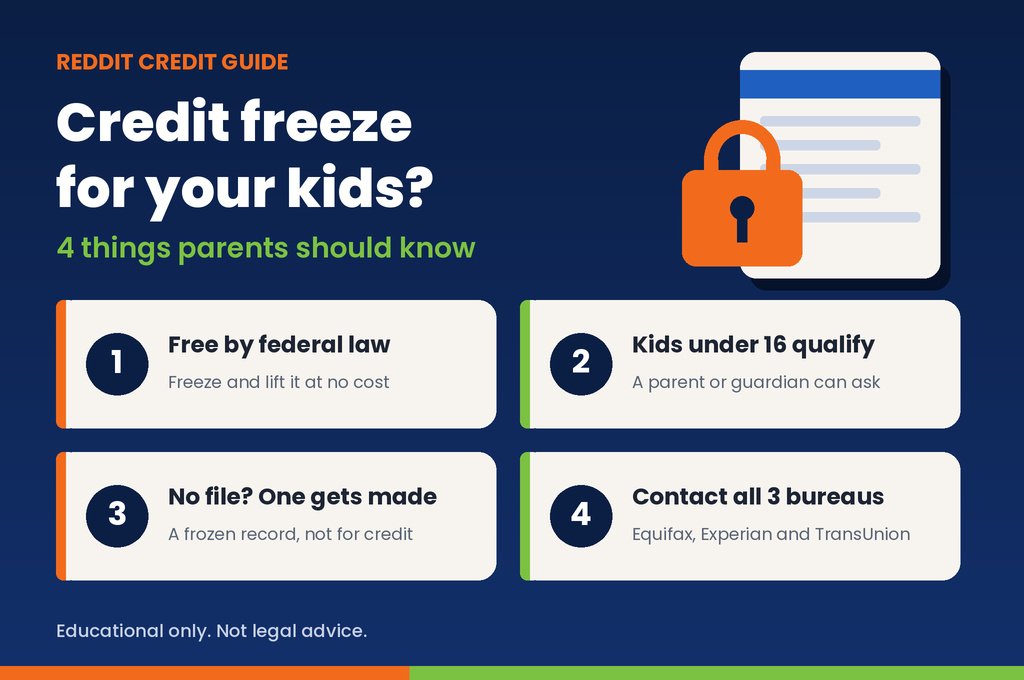
In this Reddit Credit Guide, we break down what people on Reddit are asking about a credit freeze for kids, starting with a brand-new baby. It sounds like overkill until you hear how child identity theft can go unnoticed for years. Then the next question is: will I regret it when it’s time to unfreeze?
Credit Repair Co writes plain-English guides to credit reports and the rules behind them. Learn more about Credit Repair Co, see our services, or browse the full Reddit Credit Insights collection.
A credit freeze for a newborn? The Reddit question
A recent thread on r/personalfinance started with good news: a first baby, and the Social Security card had just arrived in the mail. The parent’s first instinct was to contact all three credit bureaus and freeze the baby’s credit. They’d heard stories about kids turning 18 and finding out someone had been using their identity for years.
But they’d also read the opposite kind of story, about grown kids who couldn’t get the freeze lifted when they needed a student loan or had to pass a background check. So they asked: is 18 years of protection worth the headache later?
The replies were split in a useful way. Some people said to go ahead because lifting a freeze takes a few minutes. Others said there’s no rush for a newborn, and one pointed out that requests for kids may have to go by mail. One parent said they froze their child’s credit after someone had already misused the child’s information. Let’s sort out what’s actually true, using what the law and the Consumer Financial Protection Bureau say.
What a credit freeze does, and what it doesn’t
The CFPB’s definition is short: a credit or security freeze "prevents prospective creditors from accessing your credit file" (CFPB). Since most lenders won’t open an account without checking your file, a freeze makes it a lot harder for an identity thief to open new credit in your name. The catch is that it blocks you too, until you lift it.
A few more things the CFPB spells out:
- It’s free. You can freeze and unfreeze your records for free at Equifax, Experian and TransUnion, but you have to contact each one separately.
- It doesn’t touch your score. The CFPB says security freezes "do not impact your credit scores in any way whatsoever."
- Some people can still see your file. That includes creditors on accounts you already have, certain government agencies like child support agencies, and companies you’ve hired to monitor your credit. You can still get your own reports, too.
- A lock isn’t better. The bureaus also sell "credit locks," often bundled with paid services. The CFPB says locks are no more effective than freezes, which are free and which you have a right to by law.
It’s also worth knowing what a credit freeze won’t do. It won’t remove anything that’s already on a report; as the CFPB has put it, a freeze "won’t affect anything already on your credit report" (CFPB). And the CFPB notes the federal law requiring free security freezes "does not apply to someone who requests your credit report for employment, tenant-screening, or insurance purposes."
Can you put a credit freeze on a child’s credit? Yes, if they’re under 16
This is the part that surprises a lot of parents. Since September 21, 2018, federal law has let parents and guardians request a free credit freeze (the law calls it a security freeze) for a child under 16 (CFPB). The law calls these kids "protected consumers," and it defines a protected consumer as someone who is under 16 at the time the freeze is requested, or an incapacitated person or someone with a court-appointed guardian or conservator (15 U.S.C. § 1681c-1(j)).
Here’s the detail that answers the newborn question: most babies don’t have a credit file at all. That’s fine. If a bureau has no file when you ask, the law says it has to create a record just so it can freeze it. That record can’t be used to judge the child’s creditworthiness. It exists only to sit there, frozen.
To freeze a child’s credit, you’ll usually need two kinds of proof:
- Proof of authority to act for the child, such as a birth certificate or other government document showing parentage, a court order, or a valid power of attorney. For a child in foster care, a written letter from the county welfare or probation department can work.
- Proof of identification for you and the child, such as a Social Security number or a copy of the card, a certified copy of the birth certificate, or a driver’s license or other government ID.
Once a bureau gets a proper request, it has 1 business day to place the freeze if you asked by toll-free phone or secure electronic means, or 3 business days after a mailed request arrives. It then has 5 business days to confirm and explain how the freeze can be removed.
Each bureau handles kids a little differently. The CFPB says TransUnion and Experian have online forms for parents, while Equifax requires parents or guardians to contact it by mail (CFPB). Check each bureau’s site for its current process before you send anything.
Do kids even have credit reports?
Usually not. The CFPB says children under 18 generally don’t have credit reports unless someone with a similar name got credit and a file was created in error, an identity thief got credit in the child’s name, or the child is an authorized user or joint account holder on an adult’s account. The CFPB also cites one study that found about 2.5 percent of U.S. households with children under 18 had experienced child identity fraud at some point. Thieves like kids’ Social Security numbers because there’s no credit history to flag the fraud, and nobody’s looking for years.
The unfreeze worry: what happens when your child grows up
This was the real fear in the Reddit thread, so let’s be specific. Under the law, a child’s credit freeze stays in place until someone with the right to remove it asks. That can be the parent or guardian who represents the child, or the young person themselves once they’re 16 or older (15 U.S.C. § 1681c-1(j)(4)). California’s Attorney General describes it the same way: the freeze stays on until you say so, or until your child removes it after turning 16 (California AG).
Once a bureau gets a removal request with the required proof of identification and authority, the law gives it 1 hour for requests made by toll-free phone or secure electronic means, and 3 business days for mailed requests. A temporary lift of the credit freeze, for a set period, is also allowed.
So, will it be painless? Not always. Websites change and phone menus can be frustrating. But you can make it much easier on your future self:
- Keep the credit freeze confirmation letters from all three bureaus in one folder.
- Write down the date you placed each freeze and how you did it (online, phone or mail).
- Store copies of the documents you used, like the birth certificate and Social Security card, somewhere safe.
- When your child is old enough, sit down together and walk them through how to lift and re-freeze it.
That last point matters more than it sounds. Money.com wrote this week about a different r/personalfinance thread: a husband had frozen his wife’s credit, he passed away, and the family couldn’t get into the online account to lift it. The advice there was to call the bureaus directly. The lesson for parents is simple: don’t let the freeze details live only in one person’s head or email inbox.
Reddit credit freeze tip: put a reminder on your calendar for your child’s 16th birthday. That’s when they can start managing the freeze themselves, and a good time to make sure nothing has shown up in their name.
Before a credit freeze: check whether your child already has a file
A credit freeze only stops new accounts. If someone has already used your child’s information, the damage is sitting in a file right now. That’s why the CFPB suggests asking each nationwide bureau to search for a credit report in the child’s name (CFPB).
Warning signs the CFPB mentions include bills, credit card offers or debt collection calls in your child’s name. Mix-ups happen too: the CFPB notes that a child’s credit information can get mixed up with a parent’s when they share the same name.
If you find something wrong, the CFPB says to dispute it with both the credit reporting company and the company that held the account. If it’s child identity theft, explain that the child is a minor who can’t legally enter into a contract, send the FTC’s Uniform Minor’s Status Declaration with a letter asking the bureaus to remove the accounts, inquiries and collection notices tied to the child, and report it at IdentityTheft.gov, the FTC’s identity theft site.
Credit freeze rules for adults work the same way
Some of the Reddit replies weren’t really about babies. A few people said they keep their own credit frozen and lift it only when they apply for something. The timing rules for adults are almost the same as for kids, and the official USAGov page lays them out plainly:
| Request | What the law says |
|---|---|
| Place a freeze | Within 1 business day if you ask online or by phone; within 3 business days after a mailed request arrives. |
| Confirmation | The bureau has to confirm in writing within 5 business days and explain how to remove the freeze. |
| Lift or remove it | Within 1 hour online or by phone; within 3 business days by mail. |
| Temporary lift | Same timing, for the period of time you choose. |
| Cost | Free to place and free to lift at Equifax, Experian and TransUnion. |
One more thing to know if you keep your own credit freeze on: if a lender asks for your report on a credit application and you don’t let them access it, the law says the lender may treat your application as incomplete (15 U.S.C. § 1681c-1(i)). So lift the credit freeze before you apply, and ask the lender which bureau it uses if you only want to lift one.
A freeze isn’t the only tool. If you think someone has your information, the CFPB says you can also place a fraud alert, which tells creditors to take steps to verify your identity before opening a new account. An initial fraud alert lasts up to a year unless you remove it sooner.
How to set up a credit freeze for your child, step by step
- Gather documents. Your ID, the child’s Social Security card or number, and a certified birth certificate or other proof that you can act for the child.
- Check for an existing file. Ask each bureau to search for a credit report in your child’s name, and fix anything you find first.
- Contact all three bureaus. Equifax, Experian and TransUnion each need their own request. Expect at least one to want it by mail.
- Save the confirmations. Each bureau has 5 business days after placing the credit freeze to confirm it and tell you how to remove it. File those letters.
- Hand it off later. Once your child is 16 or older, they can ask for the freeze to be removed. Show them how, and lift it only when they actually need credit.
Most of the work is the paperwork up front. After that, it’s a folder in a drawer.
When a credit freeze comes too late: report errors and identity theft
Our credit repair team disputes inaccurate items with the credit bureaus and the companies reporting them, and you can get a free review at no out-of-pocket cost. If you or your child already has accounts from identity theft, a mixed file, or wrong late payments, balances or remarks on a credit report, and it led to a denial, Credit Repair Co’s Program 2, a Free Report Error Review by Our Legal Partners may be worth a look. It covers errors on credit reports, employment background checks, tenant screening reports and insurance reports. The attorneys we work with review your situation at no out-of-pocket cost to you and let you know whether they can help and what your options are. Under the Fair Credit Reporting Act, a consumer may be entitled to compensation and to have inaccurate information corrected or deleted.
To be clear about what that is and isn’t: Credit Repair Co is not a law firm, and report error reviews are done by the attorneys we work with. A free review doesn’t guarantee that anyone can take the case or that you’ll get any particular outcome, and results vary from person to person. Time limits can apply, so keep your reports, denial letters and notes together and reach out while the details are fresh.
Credit freeze FAQ
Can I freeze my newborn’s credit?
Yes. Federal law lets a parent or guardian request a free credit freeze for a child under 16. If a bureau has no file on the child, it has to create a record just so it can freeze it, and that record can’t be used for credit decisions.
Does a credit freeze cost anything or hurt a credit score?
No. The CFPB says you can freeze and unfreeze your credit for free at Equifax, Experian and TransUnion, and that security freezes don’t affect credit scores at all.
How does my child unfreeze their credit later?
The freeze stays until it’s removed. A parent or guardian can ask for removal, and so can the young person once they’re 16 or older, with proof of identity. The bureau must remove it within 1 hour of a phone or online request, or 3 business days by mail.
Is a credit lock the same as a credit freeze?
Not quite. Locks are sold by the credit reporting companies, often bundled with paid services. The CFPB says locks are no more effective than security freezes, which are free and which you have a right to by law.
What if my child already has a credit report?
Ask each bureau for a copy and review it. Dispute errors with both the bureau and the company that reported the account. For child identity theft, the CFPB suggests sending the FTC’s Uniform Minor’s Status Declaration and reporting it at IdentityTheft.gov.
Related Reddit Credit guides
Want to keep going after this Reddit credit freeze guide? Our credit report errors guide covers how disputes work across all three bureaus. If a report ever mixes your information with someone else’s, read our guide to tenant screening and mixed identities. And for help with inaccurate items on your regular credit reports, see our page on credit report repair services.
The takeaway: 5 free, smart tips
- Check whether your child already has a credit file before you freeze anything.
- Place a free credit freeze with Equifax, Experian and TransUnion, one request each.
- Keep the confirmations, the date and the documents you used in one folder.
- Lift your own freeze before you apply for credit, and only at the bureau the lender uses if you know it.
- Teach your child how to manage the freeze once they turn 16.
A credit freeze won’t fix what’s already on a report, but for a newborn with a clean slate, it’s one of the simplest protections out there. Many people in the Reddit thread landed in the same place: do it, write it down, and don’t let it become a mystery later.
This article reflects CFPB guidance and federal law available through November 22, 2026. It describes general situations, not any specific case, and bureau procedures can change, so check each bureau’s site before you send documents.
Worried about what’s already on your report, or your child’s? Call 415-569-3151 (Mon–Fri, 9am–5pm Pacific), visit Credit Repair Co, see our services, watch our reviews and results, read why thousands trust us, or contact us for a free review. Educational only. Not legal advice.
Sources: Reddit r/personalfinance thread: freezing a newborn’s credit (Oct. 2026); CFPB: What is a credit freeze or security freeze on my credit report?; CFPB: How do I check to see if a child has a credit report?; CFPB (archived blog): New protections available for minors under 16; 15 U.S.C. § 1681c-1 (security freezes in (i); protected consumers in (j)); USAGov: How to place or lift a security freeze on your credit report; California Attorney General: How to freeze your child’s credit files; IdentityTheft.gov (FTC); Money.com: Dad put a freeze on mom’s credit. How do we lift it? (Nov. 20, 2026); AnnualCreditReport.com